Structure abrasion: act early to protect
Alpine hydroelectric structures are subject to severe abrasion. HYDRO has developed a framework for diagnosing, assessing and addressing this deterioration before it worsens.
Gravel, sand and mineral particles transported by water cause structures to wear gradually over time. This phenomenon, known as abrasion, also affects water intakes, tailraces, spillways, concrete aprons, stone facings and metal linings.
The intensity of this wear depends mainly on the geology of the catchment and exposure to sediment transport. Facilities fed by alpine catchments rich in quartz are among those subjected to the greatest wear. Under these conditions, the materials are subjected to intense polishing, erosion and, in some cases, even impact from large rocks.
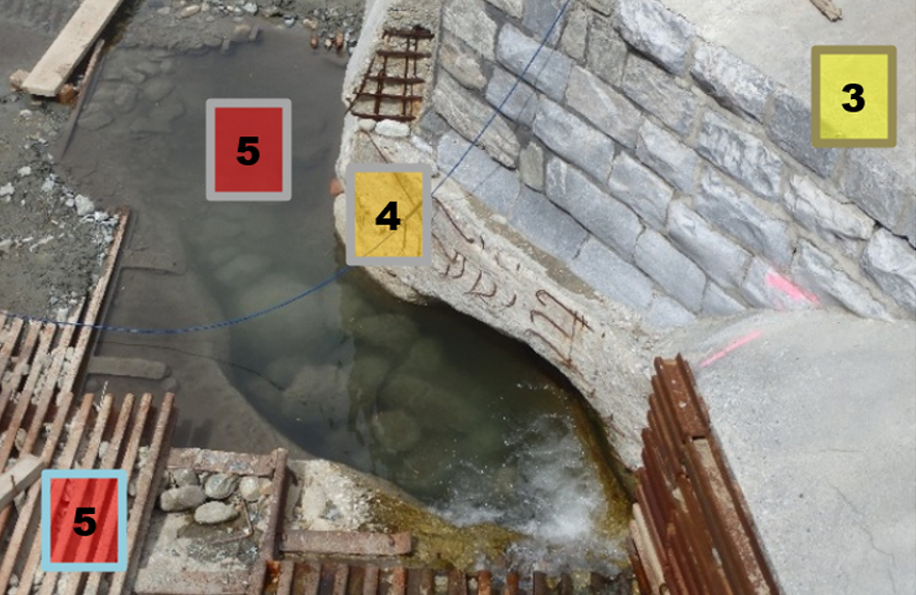
At this water intake, photographed after a severe flood, the concrete apron has been destroyed (5), the lining rails have either been washed away or are about to be, abrasion has exposed the reinforcement of the foundations and a buttress (4), and the masonry joints have been severely damaged (3).
A change in conditions can accelerate abrasion
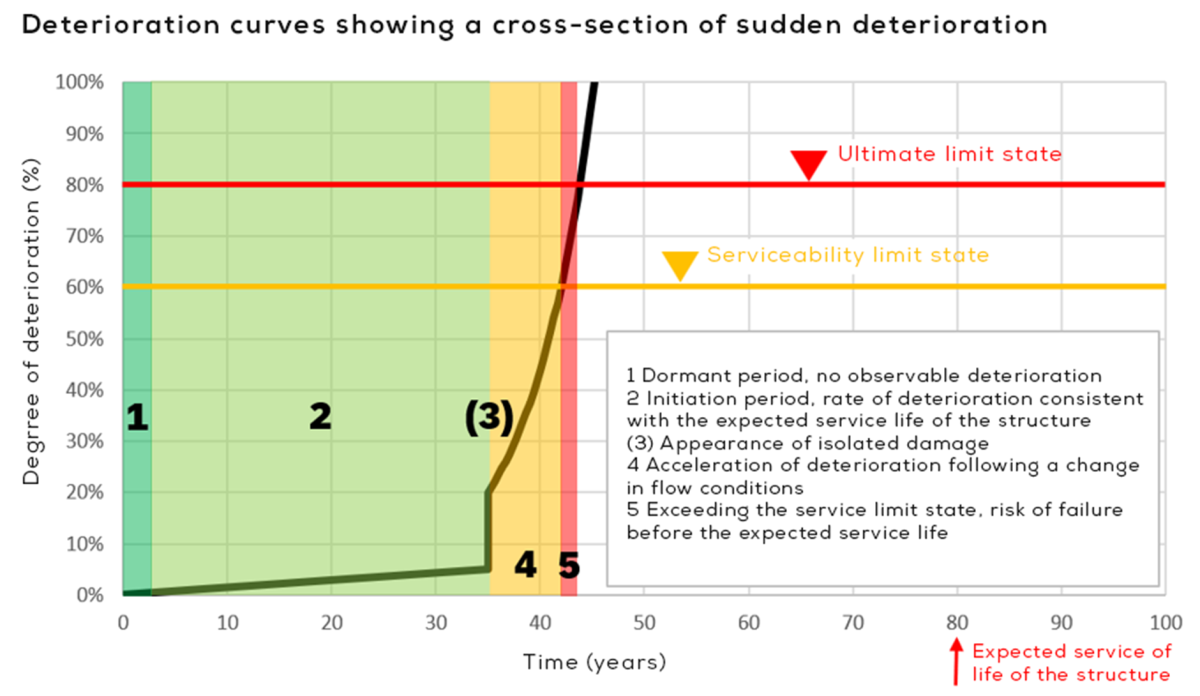
However, the experience gained by HYDRO shows that the main danger is often not abrasion itself, but its sudden acceleration. As long as the hydraulic forms of a structure remain intact, deterioration usually progresses slowly. On the other hand, if a masonry joint is eroded, a block is lost, a lining becomes deformed or a cavity develops in a concrete apron, the flow of water is disturbed. This creates localised turbulence and vortices, concentrating abrasive forces on already weakened areas. This progression is illustrated by the deterioration curves used in our new technical standard.
Building on lessons learned
In order to standardise practices within the company, HYDRO has developed a damage classification system based on five assessment levels. This framework is supplemented by abrasion exposure classes, standardised terminology, examples of damage observed at our facilities and a catalogue of prevention, protection and repair measures.
The aim is twofold: to make inspections more consistent while also making it easier to integrate new employees. Reference photographs and lessons learned from experience make it possible to compare conditions observed in the field and to apply consistent assessment criteria across the company.
Intervene before the structure deteriorates
For structures with high exposure to abrasion, the adopted strategy is to intervene before the damage enters an accelerated phase. Repointing masonry joints, replacing missing blocks, repairing cavities in the aprons and rectifying defects in protective linings can all help avoid much more extensive repairs a few years down the line.
This standardisation work forms part of a broader approach to build on the expertise developed by HYDRO’s teams and to create a set of technical guidelines covering the main deterioration mechanisms affecting civil engineering structures.
